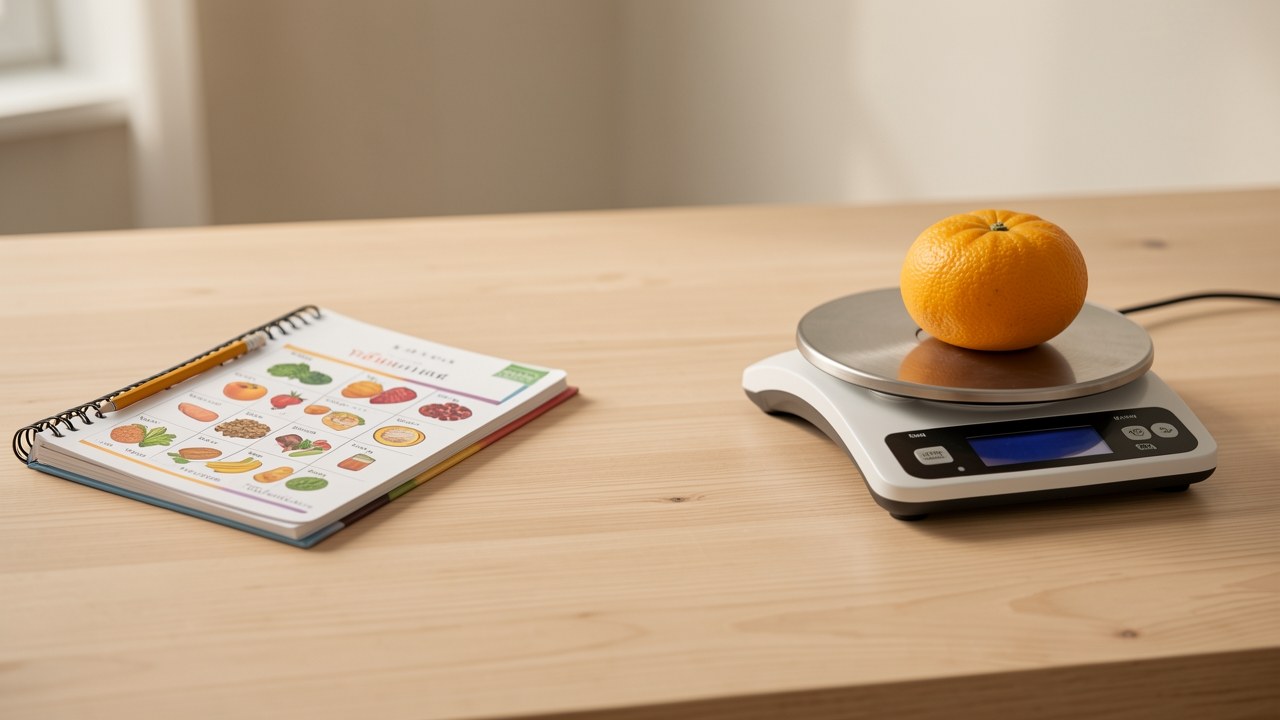
Why Tracking Matters in a Calorie Deficit
A calorie deficit is the cornerstone of weight loss, but the best way to create and maintain that deficit is a personal decision. Research from a comparative effectiveness trial shows that both calorie counting and portion-based approaches like MyPlate can support weight management, which suggests that adherence and consistency matter more than the specific method. Tracking your intake helps you understand patterns, but the method must fit your lifestyle or you are unlikely to stick with it.
The core challenge is that humans are poor at estimating portions and energy intake. This means that even if you are careful, your internal gauge may be off, and a structured tracking method can provide a more objective picture.
Sources: NCBI Bookshelf, Harvard Health Publishing
Manual Logging: Pros and Cons
Manual logging means writing down what you eat—whether in a paper diary, a spreadsheet, or a notes app—and looking up calorie values yourself. The main advantage is that you control the details: you can record exact portion sizes, preparation methods, and brands. This can be more accurate than quick app scans when you take the time to weigh and measure.
The drawbacks are significant. Manual logging is time-consuming and requires consistent effort. Some sources suggest it can interfere with social events, create stress and anxiety around eating, and may lead to cycles of strict tracking and overindulgence because it is hard to sustain. It also risks an unhealthy obsession with numbers. For some people, the effort leads to logging fatigue, which undermines long-term success.
- Control over detail: record every ingredient and brand.
- No dependence on technology or apps.
- Time burden can be high.
- May increase anxiety around food and dining out.
Sources: NutriFit
Mobile Apps: Pros and Cons
Mobile apps like MyFitnessPal, Lose It!, and Cronometer have made calorie tracking far more convenient. They offer large food databases, barcode scanning, and often a quick log-in process. The 2019 review of seven popular diet-tracking apps found that, on average, their energy estimates differed from USDA data by only about 1.4%—a small margin for most purposes. However, the same review noted that most apps tend to underestimate energy intake compared with reference standards, and accuracy varies by dietary context.
The ease of use is a major plus for sustainability. Apps reduce the effort required to log meals, which can help you stay consistent. However, they are not perfect. Crowd-sourced food entries can be inaccurate, and subscription costs can add up. The 2024 study comparing manual logging and AI-image recognition found that manual logging could overestimate energy intake for Western diets and underestimate it for Asian diets by up to 350–400 kcal per day, a reminder that database entries may not reflect your specific meal.
Whether apps lead to better weight loss than simpler approaches is still unclear. The comparative effectiveness trial found that calorie counting and a MyPlate-based approach both reduced waist circumference at 12 months, with only calorie counting significantly reducing hunger. This suggests that the app itself is not magic; the structure it provides may help some people adhere better, but the underlying behavior change is key.
- Convenient database and barcode scanning speed logging.
- Average calorie differences around 1.4% in one review.
- Tendency to underestimate energy intake.
- Crowd-sourced entries can be inaccurate.
Sources: JMIR mHealth and uHealth, Nutrients, NCBI Bookshelf
Using a Food Scale vs. Measuring Cups
Weighing your food with a kitchen scale is the gold standard for measuring portions. It provides precise grams or ounces, eliminating guesswork for foods like meat, cheese, and grains. In contrast, measuring cups and spoons rely on volume, which can vary based on how finely you chop, pack, or pour. For dense foods like peanut butter or leafy greens, a cup is not a reliable indicator of calories.
A food scale is more accurate for tracking calories and macronutrients than measuring cups. However, its downside is convenience: you need to weigh each ingredient before cooking and each portion when eating. Measuring cups are quicker but can lead to inaccurate portions. For some foods, such as liquids, they are fine; for many solids, they introduce error. The choice depends on how much precision you need and your patience for extra steps.
- Scale: highest precision for portion sizes.
- Cups: convenient but less precise, especially for dense or irregular foods.
- Weighing can be impractical when eating out or at social events.
Sources: NutriFit, Science History Institute
Estimating Portions Without Weighing
When you cannot weigh your food, you can still estimate portions using visual cues and household objects. For example, a serving of meat might be about the size of a deck of cards, and a cup of cooked pasta might be roughly a fist. These methods are less accurate than a scale, and research suggests that people tend to underestimate calories anyway. One study found that overweight adults who were not trying to lose weight overestimated their exercise energy expenditure and food calories after vigorous exercise, further complicating intuitive estimation.
Eating out presents a particular challenge because you do not control portion sizes. Some strategies include asking for dressings and sauces on the side, dividing your plate in half, or ordering smaller portions. However, even careful estimates can be off. The key is to be mindful and, if you are tracking, to log the best estimate you can and note that it is an estimate.
- Visual cues can help when no scale is available.
- Estimation is prone to error; be prepared for inaccuracy.
- Strategy for dining out: ask for modifications and log your best guess.
Sources: Harvard Health Publishing
Activity Trackers and Calorie Estimates
Activity trackers and smartwatches estimate the calories you burn through exercise and daily movement, but these numbers are estimates, not measurements. While the focus of this page is on counting calories consumed, activity trackers are often used to 'eat back' exercise calories, which can derail a deficit if the estimates are inflated.
If you use an activity tracker, treat its calorie-burn number as a rough guide, not a license to eat more. The accuracy of these devices varies, and they can influence the balance of your deficit. It is safer to stick to a target intake based on your goals and use the tracker only as a general feedback tool.
- Activity tracker estimates can vary in accuracy.
- Do not rely on them for precise calorie accounting.
- Use the tracker as feedback, not as permission to eat more.
Sources: Harvard Health Publishing
Side-by-Side Category Comparison and Decision Matrix
To help you decide which method fits your lifestyle, the table below compares the main tracking approaches across several practical dimensions. The scores are not based on a formal ranking; they summarize typical experience reported in the sources. Remember that the best method is the one you can sustain accurately enough to maintain a healthy deficit.
| Method | Accuracy | Ease of Use | Sustainability | Potential Downsides |
|---|---|---|---|---|
| Manual Logging | Varies; can be precise with exact entries | Time-consuming | High risk of logging fatigue | May lead to obsession and anxiety |
| Mobile Apps | Generally good; average 1.4% difference in one review; but can underestimate | High – large databases and barcode scanning | Easier to maintain | Crowd-sourced data may be inaccurate; subscription costs |
| AI Photo Tracking | Emerging; error rates can be high, but some apps report about 85% accuracy under ideal conditions | Very convenient – snap a photo | May increase consistency due to low burden | Not accurate for mixed dishes and culturally diverse foods |
| Food Scale | Highest precision | Requires weighing each item | May be less convenient when eating out | Inconvenient for meals out |
| Measuring Cups | Less precise than a scale | Quick | Easy for some foods | Inaccurate for dense or irregular foods |
Sources: JMIR mHealth and uHealth, Nutrients, NutriFit, BuiltWithScience, Fitia, Science History Institute
Frequently asked questions
Are calorie counting apps accurate?
In a 2019 review, seven popular diet-tracking apps showed an average calorie difference of about 1.4% compared with USDA data, which is reasonably close for most users. However, most apps tend to underestimate energy intake compared with reference standards, and accuracy varies by the foods you eat. You can improve accuracy by weighing portions and using barcode scanning. A 2024 study also found that manual logging can misestimate energy intake, so no method is perfect. Apps are a convenient and generally reliable tool as long as you remain aware of their limitations.
Sources: JMIR mHealth and uHealth, NutrientsDo I need to weigh every food item?
No, you do not need to weigh every food item. Weighing is the most accurate method for portion sizes, and it is especially helpful for foods where volume is misleading, such as meat, cheese, and peanut butter. However, if weighing every item becomes a burden, you can weigh only the most calorie-dense foods or use other methods such as measuring cups or visual estimates. The goal is to find a balance that you can sustain without becoming obsessive. Even a rough estimate can be useful if you are consistent.
Sources: NutriFitHow can I estimate calories when eating out?
Eating out is challenging because you do not control portions. To estimate calories, you can use visual cues, such as comparing meat to a deck of cards, or ask for dressings and sauces on the side. Some restaurants publish nutritional information, which you can use to log. If you cannot weigh, estimate as best you can and note in your log that it is an estimate. Be aware that people generally underestimate calories, so you may want to overestimate a bit to stay on track.
Sources: Harvard Health PublishingWhat is the easiest way to track calories?
Most people find mobile apps the easiest because they provide large food databases, barcode scanning, and quick logging. AI photo tracking is even more convenient: you simply take a picture of your meal, and the app tries to identify and estimate calories. However, its accuracy can be limited for mixed dishes. The easiest method might vary by person, but apps generally reduce the effort required compared with manual logging.
Sources: FitiaCan I rely on food labels for accuracy?
Food labels are regulated by the FDA with allowable tolerances, so they are not perfectly accurate—they can be off by a certain percentage. Additionally, if you eat a serving size different from the label, you need to adjust accordingly. For more accuracy, weigh your food and use the label as a starting point, but recognize that small discrepancies are normal.
Sources: NutriFitSources
- A Focused Review of Smartphone Diet-Tracking Apps: Usability, Functionality, Coherence With Behavior Change Theory, and Comparative Validity of Nutrient Intake and Energy Estimates — JMIR mHealth and uHealth
- Evaluating the Quality and Comparative Validity of Manual Food Logging and Artificial Intelligence-Enabled Food Image Recognition in Apps for Nutrition Care — Nutrients
- Comparing Calorie Counting versus MyPlate Recommendations for Weight Loss — NCBI Bookshelf
- The Pros and Cons of Calorie Counting: Is it Worth the Effort? — NutriFit
- How to Calculate Your Calorie Deficit (And Actually Stick to It) — BuiltWithScience
- Best Food Tracking App in the US 2026: Honest Comparison — Fitia
- Counting Calories — Science History Institute
- Calorie counting made easy — Harvard Health Publishing